sunnuntai 25. elokuuta 2013

Christening


I have been writing about traditions relating to the certain calendar dates or times of the year. This month’s post is about christening party (ristiäiset). I wrote about choosing the name for the baby already in January, but I did not talk about the traditions relating to that celebration.

In Finland about 77 % of the population belongs to the Evangelical Lutheran Church, about 1 % to Orthodox Church, a bit over 1 % belongs to other religions and about 21 % don’t belong to any religion group. I’m most familiar with the Lutheran Church, so this post represents the traditions related to christening a child in Lutheran Church.

Approximately 75 % of all children born in 2012 were baptized to Lutheran religion. The christening party is usually held within 6 weeks to 2 months after the birth of a child. The party can be held at home, at parent’s parish’s premises (f. ex. chapel = kappeli or church = kirkko) or at another location (f.ex. grandparent’s home). Also baptizing parties with many children baptized at the same time are still held in the church, but very rarely. A child can also get an emergency baptize (hätäkaste) just after the birth, if the survival of the child is not certain. Anyone belonging to the Lutheran church can baptize in that situation. The child, that survived, celebrates, like other children, the christening party then also later.

In the christening the child is dressed to a christening gown (usually white, but can be also of other colors) and there is usually a pink or light blue bowtie attached to the dress. 
 The christening table is covered with white tablecloth and a Bible, a candle, a white, small linen, a small bucket of flowers and a christening bowl are placed on the table.

The parents may invite only the closest relatives and friends to the christening or they can have a bigger party. Usually the coming godparents, the grandparents and parents’ siblings with their families, grandparents, aunts and uncles are invited. So there may be only priest and 5 guests including the godparents or tens of people present at the christening. The celebration is quite short with a few psalms sung, some prayers, Our Father -prayer, confession, some Bible reading and the baptizing. In the baptizing the priest takes some water from the bowl and waters the babies hair (some priest make the hair all wet, some just touch the hair with the water).

The parents choose usually 2 - 4 godparents to their child among their own siblings or from their closest friends. A godparent must belong to a christian church, that recognizes the child baptizing of Lutheran Church (f.ex. catholic or orthodox) and at least one of the godparents has to belong to the Lutheran church. A person, who does not belong to church, cannot become a godparent.

In the old days the godparents usually took the new born to baptizing just few days after the birth, depending of course of the distance to the church. So naturally a woman still lactating was often chosen as one godparent, because she could feed the child if needed during the voyage. The baptizing happened normally on Sunday after service or just before the service. The mother was usually too weak to go to the church and also for long time she was considered to be dirty after childbirth and had to be blessed before she could enter the church again.

In the middle ages the baptizing was done by sinking the baby into the water naked after which a white linen was wrapped around the baby. The linen belonged to the church. In the 17th century christening was done only by watering the head so the first real christening gowns were made. In the 17th and 18th century the dress was usually made out of silk or velvet and could also be used later as a ceremony dress on other occasions. In the beginning of the 19th century the dress was started to be made out white cotton and the christening dress, as we now it today, was born. It could be also made out the same fabric as mother’s wedding dress had been made. By the end of the 19th century the gender of the baby was told with pink or light blue color and the dress was only used as christening gown. During the 2nd World War the babies were baptized wrapped in their mother’s wedding veil or a dress made out of the wedding dress and veil.

Nowadays the dress is typically white with some pink or light blue ribbons or bowtie. Many families still have gowns in which already the baby’s grandparent or grandparent’s parent was once baptized. Many people embroider the name and the date of a child baptized in that gown on the inner side of the hem of the gown.

The white linen set on the table for drying of the child’s head can also be a linen used in more than one child’s christening in the family and also on it can be embroidered the names and dates of the children.

The Bible on the table is usually the Bible the child’s parents have been given, when wed.

Godparents bring a remembrance gift to the child, f.ex. a spoon or a plate to which the child’s name, birthday and -time and christening day has been engraved to. Other guests bring clothes or something little to the child.

After the christening is the coffee. The table is filled usually with sandwiches or sandwich cake (voileipäkakku) and with sweet bakery like cream cake, buns, biscuits and a sweet pie or tart. The servings can be ordered from a bakery or then self made.

The baby is photographed in the christening gown with godparents, parents, grandparents and often with other guests too. The parents send to all the guests a thank you -card afterwards. Quite many parents also post a notice in the local newspaper stating the name of the new born, birthdate, christening date and birthweight and -length.


torstai 25. heinäkuuta 2013

25.07.


Today we celebrate the name's day of Jaakko (Jacob). Once again it has been 
originally celebrated in the remembrance of a saint and apostle James, son of 
Zebedee. He was the brother of John the Apostle. In Finland the day of Jacob 
ends the women's week. From 18th to 24th, only women celebrate their 
name's day. This is also the time of the year when the harvesting of the crops 
is beginning. During the women's week the weather has been thus very carefully 
followed and also the coming weather has been predicted from the weather during 
women's week. Of course people have been hoping for clear sky and rainless 
days, so that the harvesting would be successful. But we have a saying that the 
women are so sensitive to cry, that it always rains during women's week. If it 
rains much, it is going to rain the next 7 weeks. If it rains just few drops, 
it is going to be rainless for the next 7 weeks. This year it has not rain 
much. :)
The following women have their name's day during women's week

18.7.2013 Riikka (originates from Fredrika, Henrika, Ulrika)
19.7.2013 Sari, Saara, Sara, Salla, Salli (originate from the Hebrew name 
Sarah, meaning madam or princess)
20.7.2013 Marketta, Maarit, Reetta, Reeta, Maaret, Margareeta (originate from 
the Greek word margarites meaning pearl)
21.7.2013 Johanna, Hanna, Jenni, Jenna, Jonna, Hannele, Hanne, Joanna 
(originate from the man's name Johannes, Hebrew meaning the grace of God)
22.7.2013 Leena, Matleena, Leeni, Lenita (originate from Hebrew Magdalene, 
meaning a person origin from Magdala)
23.7.2013 Olga, Oili (originate from Scandinavian name Helga, meaning saint)
24.7.2013 Kristiina, Tiina, Kirsti, Kirsi, Krista, Kiia, Tinja (originate from 
Latin/Greek name Christina, meaning the female follower of Christ).

But back to Jaakko. What do we celebrate today. It used to be believed that 
Jaakko is throwing the cold stone to water. So after his day the surface 
temperatures of lakes are going to be cooling and the autumn is closing. The 
day of Jaakko used to be celebrated according to the Julian calendar (until 
1753), so the day of Jaakko was actually 5th of August if we move it to the 
calendar we use nowadays. That is the date when the surface temperatures of our 
lakes begin to cool according to the Finnish Environment Institute. The 
background of this celebration is the pilgrimage of the Saint Jacob and the 
throwing of the cold rock is seen to describe his sins and letting go of 
them. 

We also have a Jaakko that throws the stone or rock to the sea every year on 
his name's day. The chairman of the Finnish Unscientific Society (Suomen 
Epätieteellinen Seura) Mr. Jaakko Koskinen throws the rock to sea on the shores 
of Helsinki today at noon.
It is totally humoristic event, but a very nice way to concretize an old legend 
or myth.

The surface temperatures in our biggest lakes are at the moment in Southern and 
Central parts of Finland between 15 - 19 C, in Northern parts of Finland around 
10 - 15 C. The temperatures at the Baltic sea is around 15 - 17 C.


Jaakko has been given to first name to Finnish males starting from the end of 
19th century to 2012 to 61.874 men. And let's not forget that also the 
following men are celebrating their name's day today
Jaakob, Jimi, Jaakoppi

The British and Scottish kings' name James was also formerly translated to 
Finnish as Jaakko. Nowadays we use the real name and do not translate them anymore 
to Finnish. For example the father of Queen Elizabeth II is know in Finland as Yrjö 
VI (George VI), but the new born prince of Cambridge is called George also in Finland.


perjantai 21. kesäkuuta 2013

Juhannus / Midsummer


Today we celebrate midsummer eve (Juhannusaatto) in quite quiet Capital district. Yesterday there were lots queues on the roads leaving from Helsinki and the Capital district. People head to their cottages or to the cottages of their friends or relatives. To tourist Helsinki seems to be very quiet city tonight and strange because it is going to be bright the whole night. The sun is setting tonight at just before 11 pm and it is rising again at bit before 4 am. So there is not going to be dark at all and additionally they are promising clear or just a bit cloudy sky. The temperature is now almost 22 C and in the night it is going to be around 15 C. During midsummer’s nights we may even get to see the super moon in Finland. If the sky really stays clear like it is now, the full moon is going to look bigger than normally during the night. This due to the fact that the moon is now closest to earth in its orbit.

The finnish midsummer is full of old traditions, but this time I decided not to write about them. Maybe next time. Just few words about midsummer nowadays in Finland.

Very many Finns spend their midsummer with friends, family or relatives at a cottage. They barbecue food, drink alcohol and go to sauna. Some people go to the music festivals arranged throughout Finland. And very few of us stay home, if living in a city.

The midsummer weekend is often considered to be the “darkest” weekend during the summer, especially if the weather is good like it is this year. Last year 10 people lost their lives by drowning during midsummer. In year 2012 altogether 104 people drowned in Finland and 23 of them in June. So every 3,5 days a person dies by drowning. During midsummer 10 people in 3 days. If we compare it to the lives lost in the traffic, it is a lot, although we live in a land of thousands of lakes. During 2012 255 people lost their lives in Finland in traffic.

But if we stay in Helsinki, what can we do here. The shops close by midday. And most of them open the next time on Monday. The restaurants are open, at least many of them. Then we have the amusement park Linnanmäki and of course our zoo Korkeasaari. To see a bonfire (kokko), which is very Finnish, we can go to Seurasaari. It is an island very near Helsinki and they have a midsummer celebration there every year. The main bonfire is litten at 10 pm from a church boat (kirkkovene). The bonfire is built on a raft on the sea. Every year a couple is wed during midsummer celebration at Seurasaari and they get to light the bonfire. 


It used to be very popular to get married on midsummer and even today it one of the most popular times among the couples.

The following picture have been taken about an hour ago on one of the main roads leading out of Helsinki. Usually there is at least few cars any time of the day or night.


keskiviikko 5. kesäkuuta 2013

Maternity package


I just have to make a short post of a very important tradition or actually a benefit we have in Finland. The BBC News Magazine wrote about it yesterday.


Let’s start with the history of maternity clinic system. The maternity clinic system was developed by doctor Arvo Ylppö back in the 1920s. First it focused more on taking care of the children between 0 - 6 years of age, so before school. The importance of such clinic was obvious, because in the neighborhood of the first clinic the infant mortality was reduced in 3 years from 15 % to 3 %.  Quite quickly they also started to pay attention to the pregnant mothers and their wellbeing. In 1944 after the WWII the laws about maternity and child health clinics came into force and obligated the municipalities to arrange the service for the inhabitants.

The law about the maternity grant was set already in 1937 and the first packages given the following year. First it was only for the poor mothers. The reason for such packages was to get the pregnant women to come to the check-ups and to bring the child too after birth. Before the act the infant mortality was quite high. In year 1949 the maternity grant was given to every pregnant women in Finland. Nowadays a pregnant woman can choose weather to have the packages or a compensation in money. In order to get the maternity grant the pregnant woman has to visit her local maternity clinic regularly, 12 - 15 times during the pregnancy and the first visit has to be before the end of the 4th pregnancy month. The package contains clothes for the new born, diapers, a toy etc. See the content of the package from the following link.


Like the article by BBC says quite many Finnish children sleep their first nights at home in the maternity package’s cardboard box. Almost every first-time mother takes the package and only about one third of all pregnant women choose the money (now 140 €). The package is roughly worth of 300 euros.

Due to the maternity grant, the maternity clinics, child health clinics and monthly child benefit the infant mortality is among the lowest in the world, around 0,4 %. Almost every (99.7 %) pregnant woman visits the maternity clinic in Finland and almost all (99.5 %) children have their check-ups at the child health clinics.

And we also have the long maternity leave, which usually starts 30 weekdays (about 5 weeks) before the child is expected to born and lasts for 105 days. The mother may choose to stay home additional 158 weekdays. During that time the mother will get a compensation in money which is calculated based on the incomes. F. ex. a mother with 36000 euros yearly income will get 111 euros for the first 56 days and almost 85 euros a day until the 105th day. The compensation for the additional 158 weekdays is 92,5 euros for the first 30 days and after that almost 85 euros a day.

The mother can stay home until the child is 3 years old without loosing her job. She will get her job back, if she returns right after the basic leaves (the child is then about 11 months) and usually she will get the old job back even when going back to work after the child is 3. If mother stays home until the child is 3, the employer has to have a job for her, but not necessarily the old job but the salary and benefits has to be the same than before the leave.


sunnuntai 19. toukokuuta 2013

The flag of Finland


Today is the Commemoration Day of Fallen Soldiers (Kaatuneiden muistopäivä) in Finland. In 1940 Marshal of Finland Carl Gustaf Emil Mannerheim gave an order that the 3rd Sunday of May shall be celebrated in memoriam of those, who gave their lives defending Finland in Winter War (Talvisota) and in the Civil War (Sisällissota). Nowadays we honor all the people, who have given their lives defending Finland. The day is honored by visiting the war graves and also flagging with national flag. Until 1995 the flag was flown half-staff between 10 am and 2 pm. Between 8 am and 10 am and 2 pm to 9 pm the flag was flown in full-staff. Nowadays it is flown in full-staff all day (8 am to 9 pm).

The flag of Finland is white with blue cross. It is a rectangle. Its height is 11 units and length 18 units. No markings are allowed to be made on the flag and it always has to be clean and intact. Old, broken flag has to be destroyed by burning or cutting it in so little pieces, that it cannot be recognized as a flag anymore.

Finland did not have own flag until after the declaration of independency. Before as a national flag was first the Swedish national flag and then the flag of Russian Empire. But Finland has had its own national coat of arms since the 16th century. The coat of arms is the yellow/golden lion on red background. The lion has a crown, stands on a saber and holds on its right, armoured hand a sword. There are also 9 silver roses on the coat of arms. This coat of arms was many times used instead of a national flag. The idea of a national flag rose in 1848 when our national song, Our land (Maamme), was first presented in public on 13th of May in Helsinki. There were many suggestions for the national flag, including red flag with yellow cross. No national flag was yet decided. The national flag became topic again after the declaration of independency. In May 1918 the look of the national flag was decided and ever since the national flag of Finland has been white with sea blue cross. The white can be seen resembling the white summer nights or the white snow during winter and the blue reflecting the blue summer sky or the thousands of lakes.

Every Finn has the right to flag, it is not an obligation. There are 6 official flagging days annually plus the days when there are official election held and the day of the inauguration of the president. Additionally there are 13 established flagging days in Finland. These have been marked on the calendar, but they are not official. 

The official dates are
28.2. The day of Kalevala (Kalevalan päivä) also called the day of Finnish culture
1.5. May Day (Vappu), the day of Finnish work
The second Sunday of May, Mothers’ Day
4.6. The Flag Celebration Day of the Defense Force, the Birthday of C. G. E. Mannerheim
The Saturday between the 20. and 26. of June, the Midsummer Day (Juhannuspäivä) and the Day of Finnish Flag 
6.12. The Independence Day of Finland

A Finn can flag every time he or she has something, that require flagging, f.ex. birthday, wedding, christening. The flagging starts at 8 am and ends when the sun sets, by the latest at 9 pm. The flag is not allowed to be left on the pole for the night except on Midsummer. Then the flag is hoisted at 6 pm on Friday and taken down the following day at 9 pm. That’s the night of midnight sun. On Independence Day the flag can be hold on the pole until 8 pm, if it is lit after 4 pm.

When a person dies there is a half-staff flagging. The flag is then flown in half-staff on the day of death or on the next day, if the death has occurred late in the evening. On the funeral day the flag is then pulled to half-staff and raised to full-staff after the funeral service has been held.

The flag has to be always treated with dignity. It may be washed and ironed, but it is not allowed to let dry outside on the clothesline. The flag has to be hoisted and lowered peacefully and it is not allowed to touch the ground. The pole has to be seen from the main road and, if on the back yard, seen also over the house. In apartment buildings the pole has to rise to the third floor’s height. The height of the flag is about one sixth of the pole’s height. So the flag needs to fit to the pole. 

When half-staff flagging is held the flag is first hoisted to full-staff and then slowly lowered to half-staff, meaning to the height of about one third of the pole. Then the lowest corner of the flag is about in the mid of the pole. The state can order a national half-staff flagging day due to an incident that affects the whole nation. In the 21st century this has been done at least in 2004 after a bus disaster in Konginkangas (23 people were killed and 14 injured) and the Tsunami on Indian Ocean (178 Finns lost their lives), in 2007 after a school shooting at Jokela, Tuusula (9 people were killed) and in 2008 after a school shooting at Kauhajoki (11 people were killed).


tiistai 30. huhtikuuta 2013

Vappu


The April is over and the last spring month is closing awfully fast. This year the weather has not prepared us for the coming summer so far. It still is very windy and cold with temperatures near 5 - 10 C even during the day. The snow has melted.

The 30th of April is called Vappuaatto (the May Day’s Eve) and day after that of course Vappupäivä (the May Day). The celebration of Vappu starts on 30th of April.  The people (students or other), who have done their matriculation examination and have gotten their “white hat” (this year’s high school graduates will get their white hat only at the end of May), will start celebrating Vappu, when for example in Helsinki a statue called Havis Amanda has been washed and gets her own hat at 6 pm. Around Finland at 6 pm the hat is put on and the sparkling wine or champagne bottles are opened. In quite many cities a statue also gets washed and has a cap during the evening. 
Some people celebrate only on Vappuaatto by eating potato salad and sausages, drinking sparkling wine, cider or champagne and having doughnuts (without hole, filled with jam and covered with sugar), funnel cakes and sima for dessert.


On May Day then the students and other people with white hat start their day by eating outdoors in a park despite of the weather. The workers (or some of them) gather together and march through the city holding their flags. The marches were much more popular back in 1970s and before that. 

It seems that I have been focusing more on the eating side of our traditions, so why not do it also this time.

So as a main course we eat sausages, potato salad, meat balls and french fries. Sausages and meat balls are quite often ready made as well as usually the potato salad. The french fries are bought from the grocery’s freezer but they are not made in the oven, like the instructions suggest on the bag. They have to be deep fried in vegetable oil (f. ex. canola or sunflower oil).

As a dessert we have then funnel cakes, doughnuts with jam, maybe also donuts and of course sima. The doughnuts are actually buns that are deep fried in cocoa butter. They taste the best when still little warm. The funnel cakes are also made deep frying. The dough is poured into the hot oil as a very thin string and pattern is made at the same time. It is fried until it gets a nice brown colour. The ready cakes are taken out of the oil, let cool down and the slightly covered with powdered sugar.


a funnel cake

Sima is a very old traditional drink made in Finland for centuries. It is mead. And it is as best when home made. Sima was made already during the Viking times in Scandinavia. It contained quite much alcohol back then. The scandinavian mead was gradually replaced by the wines entering to Scandinavia from Central Europe. 
The making of sima as we now it today in Finland dates back to 18th century. Then it was only made by the rich people and in the mansions in Finland as it contained lemon which was expensive and not grown in Finland. It is more sweet and contains much less alcohol (only about 1 V-%) than the old traditional scandinavian mead. And it does not contain honey any more.


sima

The making of sima starts about one week before Vappu. What is needed is 8 litres of fresh water (best if boiled first), 500 g normal white sugar, 500 g demerara (= brown) sugar, juice of 1 lemon, 1 lemon pealed and cut in slices, some dark syrup, some fresh yeast (about ¼ of a teaspoon), raisins and some more white sugar. The warm water and the sugars (white & dark and the syrup) are mixed together and the lemons are added. The mixture is allowed to cool to about 37 C. Then the yeast is added and the mixture is mixed throughly. The mixture is allowed to stay in the room temperature about 12 hours. Sima is filtered and bottled into clean bottles (preferably out of glass) with 1 teaspoon of sugar/one liter and some raisins. After 6 hours the bottles are taken into the fridge or some other cool place with temperature under 10 C. The sima is ready within one week. It is ready when the raisins have rosen on top of the sima. It tastes absolutely wonderful and may have some alcohol in it, because it made by brewing. So don’t give it much to children.
Of course the children also celebrate Vappu. They get their nice folio balloons, whisks, horns, spinning tops and maybe even some masks or funny wigs.

Have a nice May Day!
Hyvää Vappua!


Watch the Havis Amanda get her hat.


sunnuntai 14. huhtikuuta 2013

Spring and tires


The spring should be here and actually is not. We still have about 40 cm snow, but the ground can be seen in some places. The nights are still cold with temperature near -5 C. The days have been little bit warmer during this week, temperature around +3 C. Next week maybe also the nights are going to be over 0 C.

Here this time of the year is a bit problematic, especially if owning a car and using it daily. The law says we have to change the winter tires to summer tires by the latest a week after Easter. This year the Easter was quite early and the spring is late, so the police is making announcements, that please you need not to change your summer tires yet. It is perfectly alright still to have the winter tires. Some people of course changed the tires as soon it was allowed and now they are hoping that the roads won’t be very slippery in the morning.

I think in quite many families this is the time, when the most interesting discussions about the car are held. It would be nice to have the summer tires on. No more noise from the spikes of the winter tires. Let’s picture it like this in a normal Finnish family:


- The roads are getting dry and I’m going to wash the car this weekend, so I shall also change the tires, husband says.
- Are you sure, the spring is not quite yet here? wife replies.
- I’m sure, it has been over + 3 C for awhile already, at least these couple of days and I’m washing and waxing the car anyway, husband corresponds.
- Okay, so do it then, wife says.

The tires are changed and the car is washed. Everything goes fine and the husband is very pleased with himself.
A week later forecast promises some snowfall and degrees under 0 C for the night. The wife is a little nervous.

- Darling, should you change the winter tires back. I need to leave tomorrow quite early, wife asks.
- No, no need. It will melt before you leave in the morning and I don’t believe it is really going to be snow and frost, husband replies.

5 am in the morning the wife wakes the husband up.
- Darling there is about 5 cm snow on the ground and the temperature is -1 C, she says.
- Okay, I shall go and change the tires, husband replies, leaves the warm bed and goes out in the cold and almost dark morning and changes the tires. He swears that next year he shall wait a bit longer before changing the tires to summer versions. And never does he actually remember that. :)


And this will happen again in the fall. The questions, do I need the change the tires already? can I wait for few more weeks? is there going to be snow already? do I need the car early in the morning?

Of course quite many people, especially in the city areas have a service changing the tires and storing them. This time of the year is really hectic in such services and it is really difficult to get a time for maintenance or ad hoc tire changing.

I personally keep the winter tires until late April. Usually everybody else already have their summer tires. And in the fall I’m one of the first to change back to winter tires. So I’m playing it safe, but the winter has never surprised me. :)


Here is some info about car tires and requirements in Finland by Liikenneturva (Traffic Safety) 


And then a guide to driving in Finland by Finnish National Traffic Police (Liikkuva poliisi) and TISPOL 


torstai 28. maaliskuuta 2013

Eating on Easter


The Holy Week is here and the groceries are full with chocolate Easter Eggs, lamb, pasch (pasha, an Easter desert made out of quark and found in the Easter table of a Greek Catholic family) and of course the traditional Finnish Easter dessert mämmi, which is made out of water, rye flour and malt and flavoured with dark sugar syrup and sour orange (pomeranssi, Citrus aurantium) peel. The making of this rye dessert is quite difficult and demands lot of time. So I prefer buying it ready made.

But let’s start with the main course. It is traditional to eat lamb and home made cheese, egg-milk and blood sausage on Easter. Nowadays the lamb can be found in many tables on Easter. As a dessert we eat mämmi or pasha
Mämmi is often served also to the foreigners happening to be in Finland at the time of Easter. I admit it may look awful, but served with the right accompaniment it tastes quite good. And not even all Finns like it. Never try to eat it warm, without cream and sugar. Mämmi is one of my favourite Finnish desserts, but I never eat it warm or as such. Mämmi has to be cooled to fridge temperature (around + 3 - 4 C) and covered with sugar and almost drowned with cream. If ever in Finland that’s a dessert one has to experience. A foreign friend of mine tasted mämmi after it had travelled on room temperature almost a day to the tropic and of course served as such. I well understand, why my friend is now quite reluctant to try mämmi again. ;) The Finns have been eating mämmi since medieval times in Western parts of Finland.


Then we of course have the Easter eggs. They can be real, boiled eggs, only egg shells, chocolate eggs or even eggs made out of gold and jewelry. The most beautiful, non eatable Easter eggs have most probably been made by P.C. Fabergé and his goldsmiths in St. Petersburg f. ex. to the Russian Tsar and his family. Quite many of the goldsmiths working in the Fabergé’s factory in St. Petersburg were actually Finns. :)

What about then the eggs, that we can eat? The variation of chocolate Easter eggs is huge. Some of them contain a little toy or other surprise in them, some are hollow and made out of chocolate and then there is the Mignon Egg.I personally prefer Fazer’s Mignon egg. It has been manufactured for 117 years. Karl Fazer brought the idea of the egg from one of his business trips to Germany. It has been made since 1896 and it is still one of the most selling Easter Eggs in Finland. Also the Russian Tsar and his family enjoyed this eatable egg. According to Fazer, this year they are manufacturing 1,5 million Mignons (and there is 5,4 million inhabitants in Finland). The Mignon is solely hand made. To a genuine, emptied egg shell a mass of mandel-nut-nougat is poured and the tiny hole in the egg shell is sealed with sugar mass. One Mignon weighs 52 g. 
From the following link you can find a video of the making of Mignon.

Before eating the Mignon one can also paint it. The painting of real, boiled eggs or f. ex. Mignons is a nice tradition we also have. The children are taught quite young to paint the Easter eggs. What is needed is boiled egg, emptied whole egg shell or a Mignon. The surface is then painted with watercolors. The style is free. The egg can be decorated with only one color or multiple colors. It can have pictures, texts or patterns. The decoration is fun doing for all, independent of age.

And on 1st Easter Day, next Sunday, if the weather is not cloudy, I shall wake up at just after 5 am and go to see the Easter Sun dancing. ;)

Happy Easter!

Hyvää Pääsiäistä!


sunnuntai 17. maaliskuuta 2013

Palm Sunday (Palmusunnuntai)


It has been a while since my last post. The Lent (paasto) is quite uneventful time. Of course not many people these days anymore fast. And actually this can be the best time of the year in Finland. We still have lots of snow (80 cm this year) also in the Southern parts, the days may be sunny with few minus degrees and the nights awesome with crystal clear sky full of stars and temperature near -20 C or even below that. A good time to go outdoors: ski, skate, take long walks in the bright sunlight. Additionally the mornings and evenings are getting brighter and longer. But back to the post’s topic.

The Easter time is closing up and the Lent is soon over. Next Sunday we are celebrating Palm Sunday (Palmusunnuntai). And there is a reason why I post this a week in advance. At least week before Palm Sunday we have some things to do, if we want to celebrate the Palm Sunday according to Finnish traditions.

First we dress up, take garden shears and go for a walk in the woods. There we seek some young birches (koivu) and cut branches from them, naturally we have asked a permission for that from the owner of the forest. We also look for willows (paju). The willows already have catkins (pajunkissa). We cut few branches with catkins and head home. At home we put the birch branches into water and after a week we shall have very small leaves and can decorate the branches. The willow branches can be left on the table without any water. There is one more thing to do. We take some soil and plant some grass seeds on it, cover them with clear plastic, place in light and keep humid. On Palm Sunday there shall be nice green grass (rairuoho) to decorate.

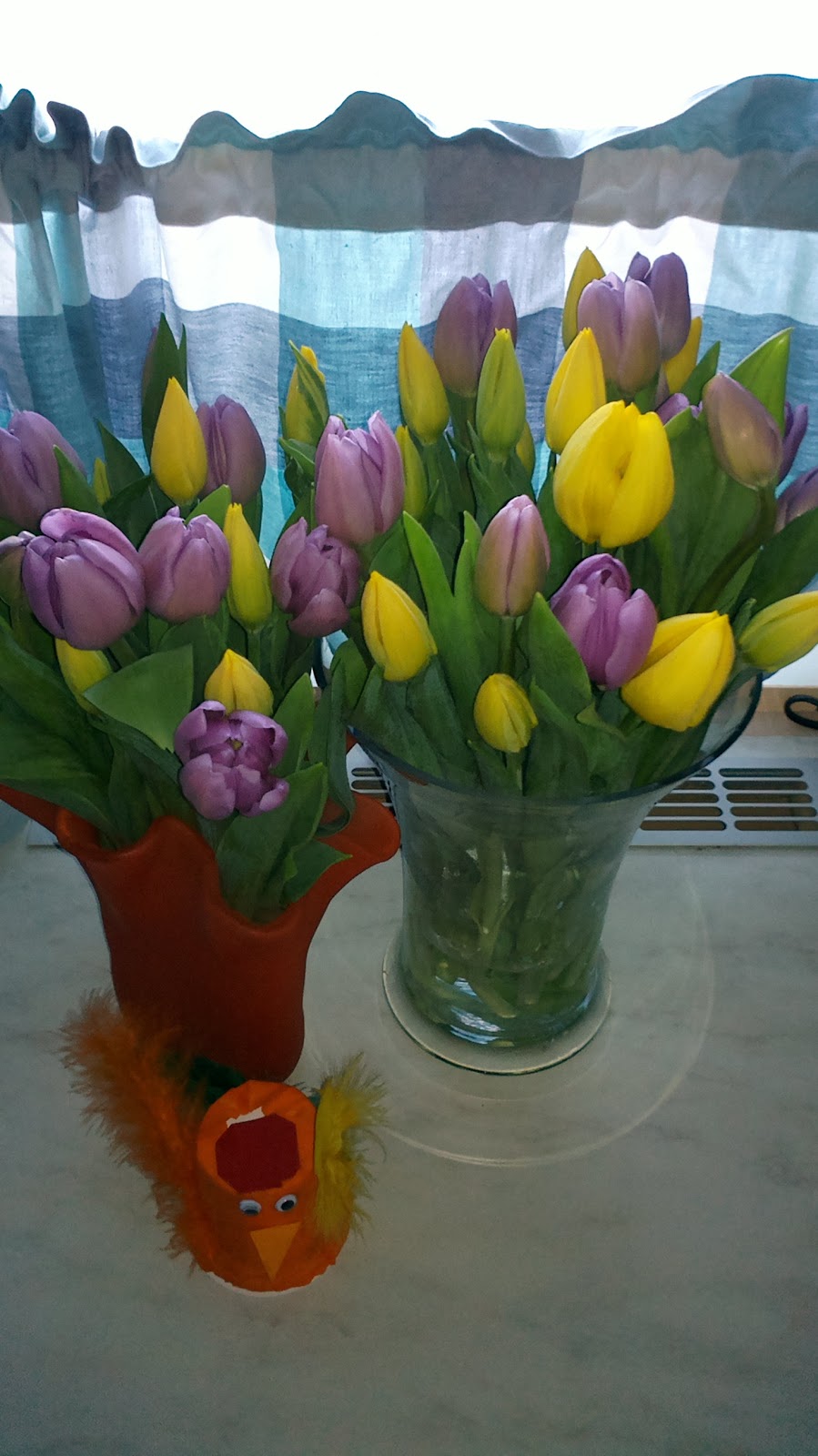
On Palm Sunday we decorate our house with bright yellow (to mark the sun, the spring and joy) and green (marking new growth, spring and hope). We may also use some violet (to remind us about the sufferings of Jesus and repentance we should feel). The grass gets small, usually yellow chickens and white bunnies. On the branches of the birch we put  some birds, feathers and small witches. Yes, witches. They have bright colored clothes, a broom, a cat and also a coffee pot. To the same vase we add tulips and daffodils in bright yellow and red.

On Palm Sunday we have even a tradition for the children. Its roots are in the Eastern Finland, and also somewhat in the Western Finland. Young children are dressed up as Easter witches. The children make so called wicker (vitsa), with which they virpoa (wave the wicker) a person and read a poem at the same time. The poem wishes good luck, good health for the coming year. The wicker is given to the person and the child gets a reward, usually a chocolate Easter egg. The wicker is made out of willow branch with catkins and decorated with colorful silk paper rosettes. The children tour around in the neighborhood from door to door. It resembles the Halloween tradition of children in USA.

Originally the wickers were blessed in a service in Orthodox churches on Saturday, the day before Palm Sunday. Then on Palm Sunday the children would wave the wickers to their family or relatives to remember the palm leaves salute done to Jesus and to bless their close-ones in this way. The “pay” (palkka) the children got, could be collected only on Easter after the Lent was over. The children were not dressed up. 

In Western Finland the people believed in witches (pääsiäisnoita or trulli), who would fly in the night between Good Friday (Pitkäperjantai) and the following Saturday and try to curse the house and steal the livestock, because the protection of God was at the lowest due to the death of Jesus on Good Friday. People lid up bonfires (kokko) to keep the witches and bad spirits away. At some parishes lonely women living outside the society would dress up as witches and scare the residents of the parish.

So actually two totally opposite traditions, the good blessing done by the Orthodoxes with wickers in the Eastern parts of Finland and the cursing done by witches in the Western parts of Finland, have nowadays been combined into the same tradition done by children. Many people don’t remember any more the original traditions. Especially the Orthodox Church has tried to tell about their original tradition and how it should be celebrated.

Right or wrong? Mixing old traditions? Maybe, but the children have fun. Most of them are dressed up so cutely and well. And I get beautiful willow wickers, with which I can decorate my house. And I get to see the joy on the children’s faces when they get to choose from the chocolate eggs I have reserved for them.

Virvon, varvon.
Tuoreeks, terveeks.
Tulevaks vuodeks.
Lahja sulle, palkka mulle.

Have a peaceful and sunny Easter time!


maanantai 11. helmikuuta 2013

12.02.2013 Shrove Tuesday


Today we celebrate Shrove Tuesday (Laskiaistiistai) in Finland. Once again a tradition, that  originates from catholic habits. The fasting before Eastern starts tomorrow, so people used to eat well and celebrate today before the fasting.

Nowadays we go sliding. We take our sledges, or actually it is a pulka or a toboggan (pulkka) and ride down hill on it on the snow. It is really fun. And it is not just for the kids or young adults. People from every age group does it. In the old days people used to shout long flax (pitkiä pellavia) while sliding down hill. With that people hoped for a good flax crop in the summer. The flax fibers would be longer, if the pulka would glide far.

The university students usually have some great parties on Shrove Tuesday. First they go sliding and afterwards go f.ex dancing in the evening. The best sliding team is awarded with something. University of Turku student association is also having a happening today.

(there is also the text in English, just slide down a little bit ;) )

After spending few hours gliding (pulkkaillen) we go inside and have for lunch pea soup (hernekeitto), a soup with peas and onion and pork meat, and as a dessert some hot juice (kuuma mehu) or hot chocolate (kaakao) and a bun (pulla). The bun is a Shrove bun (laskiaispulla). It is made like a normal wheat bun. After baking it is cut horizontally in half and filled with whipped cream (kermavaahto) and either strawberry jelly (mansikkahillo) or almond dough (mantelimassa). The filled bun is then placed on a deep plate and slowly hot milk, spiced with some vanillin sugar, is poured around it. Then it is eaten with spoon.

Liukasta Laskiaista! (Slippery Shrovetide!)


torstai 24. tammikuuta 2013

25.01.2013 St. Paul’s Day


In Finland we celebrate our Name’s Day (nimipäivä). When a child is born, his or her name has to be informed to the authorities within 2 months of the birth. The child can have one to three names plus surname. The parents choose the names from old family names or names they like. The name has to be appropriate. A girl cannot get a boy’s name and vice versa. The written form of the name has to be according to the national language regulations. The name is not allowed to be offensive. Usually the child is given a first name, that can be found from the Finnish name day calendar.

The name day calendar is published by the University of Helsinki and it is updated every five years. A new name is added to the calendar, when at least 500 people has been given that name. Quite many people celebrate their name’s day, for example by taking some biscuits or buns to their workplace or inviting close friends or relatives to home for coffee and some sweets. Children get some small gifts from their parents, grandparents and other close relatives. There are only two days during the year, when nobody celebrates name’s day: Christmas Day and New Year’s Day.

The name day calendar is originally based on the catholic saints’ calendar, where every saint had their own day. After the Catholic religion came to Finland, the Finns started to give their children names according to the saints. Before the names were more related to nature, like Morning (Aamu), Evening (Ilta), Wind (Tuuli) or Bear (Kontio), or to characters the parents wished for their child, like Shooter (Ampuja), Power (Valta) or Knowledgefull (Tietävä). The reformation came to Sweden-Finland in the 16th century, but the tradition to spend name’s day did not vanish. 

Before the end of the 19th century also quite often the name of the child was decided by the priest baptizing or a first born son was given the first name of his father. At the end of the 19th century also names, that were not based on Christian names were started to be added to the calendar. During the years of Russian Empire’s oppression quite many Finns changed their Swedish or Russian names to its Finnish form. Just after the Independency in the 1920s and 1930s many people also changed their Swedish or Latin based surname into its Finnish form or took a new Finnish surname.

Nowadays in the name day calendar mostly on a day there are only manly or womanly names. In some day’s there are both names, like the 19th of January, when we celebrate the names of Heikki, Henri, Henrik, Henrikki (all man’s names and Finnish versions of Henric or Henrik) and Henna, Henni and Henriikka (woman’s names and based on the woman’s name version of Henric, so Henrietta or Henrika).

On the 25th of January we celebrate Paavo, Pauli, Paul and Paavali (all man’s names and based on the Latin name Paulus, that means small or humble). This day is thought to be the day, when Paul the Apostle (apostoli Paavali) converted to Christianity.

In the old traditions there is a belief, that the mid of winter is reached at the day of Saint Paul. So now the days are getting brighter and half of the snow has snowed. The old folks also believed, that on Paul’s day the bear is turning around in his nest and people had to have at least two thirds of the food left, otherwise they would be hungry before the new crop. People also expected cold for this day, because it would mean a good crop in the summer and warm summer. 

The weather now at Helsinki-Vantaa airport


The calendar office of the University of Helsinki